
Lesson archive · Pack 003
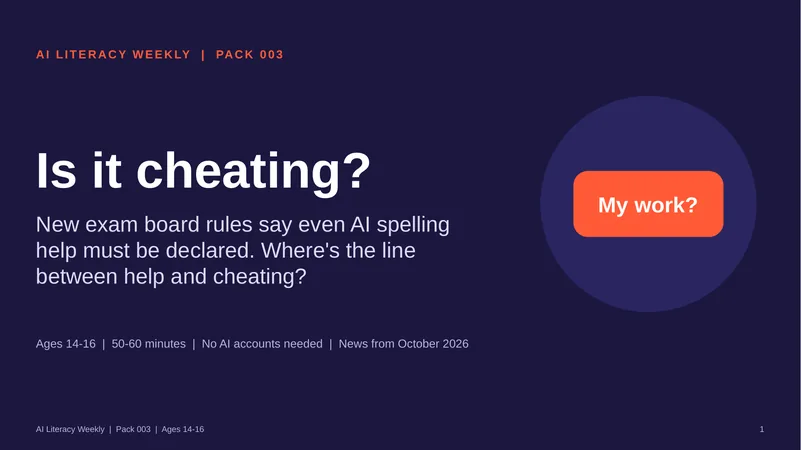
Is it cheating?
AI, homework and the new exam board rules. Pupils learn the exam boards' updated AI rules for coursework, sort invented cases into OK, no marks or misuse, see how real cases ended, and debate where the line between help and cheating should be.
For the week of Monday, 2 November 2026. The Joint Council for Qualifications (JCQ) has updated its AI rules for coursework for the 2026-27 school year (latest version dated 13 October 2026): hidden AI help with planning, spelling, grammar or translation now counts as misuse. Research from Oxford University Press found only 15% of UK teens say they've had enough guidance on AI.
At a glance
- Ages: 11-14 (KS3), 14-16 (KS4), 16-18 (Post-16). Members get a full version for each age band, with its own slides, plan, worksheet and teacher guide.
- Length: 60 minutes, with 45-minute and 20-minute (tutor time) versions
- Subjects: Computing, PSHE/RSHE, Citizenship, Tutor time
- Big question: When does getting help from AI stop being your own work, and who gets to decide?
Learning objectives
- Explain the exam boards' rules for AI in coursework: ask first, acknowledge it properly, and marks only for your own work.
- Apply the rules to decide whether a use of AI is OK, earns no marks, or is misuse, and (16-18) predict the penalties in real anonymised cases.
- Evaluate where the line between help and cheating should be, using evidence and at least two viewpoints.
What's in the pack
- One-page START-HERE sheet: the story, a run sheet for 60, 45 and 20 minutes, what to print and common misconceptions
- Slide deck (15 slides, PowerPoint and PDF) with starter and exit quizzes, diagrams, and a teacher script, timings and sources in the speaker notes
- Two-sided pupil worksheet: starter quiz, write-in 'OK, no marks or misuse?' sort (16-18: predict the penalty in real cases), guided verdict and exit quiz
- Teacher guide with answers, common misconceptions, background on the JCQ rules and real cases, a fact check and safeguarding notes
- Lesson plan with differentiation and curriculum links
Curriculum links (England)
| Area | How this lesson covers it |
|---|---|
| Computing KS3 and KS4 | Using AI tools responsibly in schoolwork, their limits (made-up facts, detectors that can be wrong) and how use is checked. |
| RSHE: online safety and awareness | Thinking critically about AI chatbots and new technology, here in the context of homework and coursework. |
| PSHE: living in the wider world | Learning skills, honesty and digital resilience: asking for help and managing coursework. |
| Citizenship | Who makes exam rules, whether they are fair, and a structured debate (KS4) or vote line (KS3). |
| Post-16 | EPQ and NEA induction: the JCQ rules, the declaration of authenticity, evidence of process and real malpractice cases, with a formal debate. |
| Tutor time | Study skills before coursework starts, using the 20-minute version. |
Safeguarding
Low sensitivity. The main risks are pupils disclosing that they have cheated, worry about work already handed in, and pupils feeling accused; the teacher guide covers each. Nobody is asked whether they use AI, and no pupil needs an AI account or a device.