
Lesson archive · Pack 001 · Free sample
Made with AI?
YouTube Music's new AI labels. Pupils sort real examples into YouTube's three AI labels, learn how platforms spot AI-generated music, and debate whether a label is enough.
For the week of Monday, 19 October 2026. On 14 October 2026 YouTube Music began labelling songs created primarily using generative AI.
At a glance
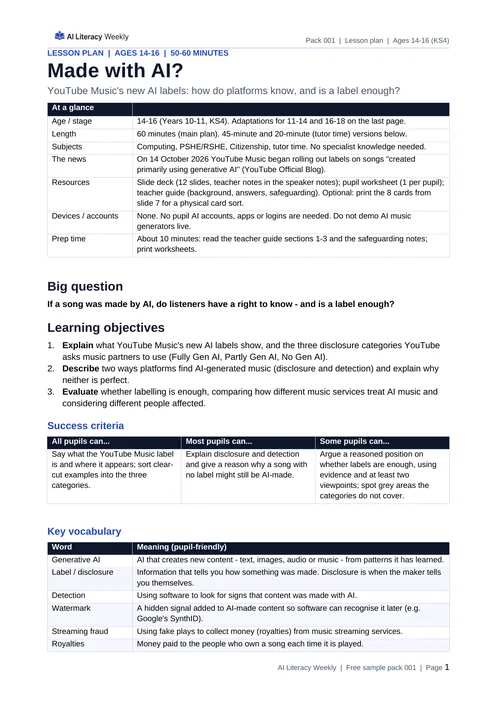
- Ages: 11-14 (KS3), 14-16 (KS4), 16-18 (Post-16). The free sample is the 14-16 (KS4) version, with notes for adapting it for 11-14 and 16-18. Members get all three versions in full.
- Length: 60 minutes, with 45-minute and 20-minute (tutor time) versions
- Subjects: Computing, PSHE/RSHE, Citizenship, Tutor time
- Big question: If a song was made by AI, do listeners have a right to know, and is a label enough?
Learning objectives
- Explain what YouTube Music's new AI labels show, and the three disclosure categories YouTube asks music partners to use (Fully Gen AI, Partly Gen AI, No Gen AI).
- Describe two ways platforms find AI-generated music (disclosure and detection) and explain why neither is perfect.
- Evaluate whether labelling is enough, comparing how different music services treat AI music and considering different people affected.
What's in the pack
- Slide deck (12 slides, PowerPoint and PDF) with a teacher script, timings and sources in the speaker notes
- Lesson plan with 60, 45 and 20-minute options, differentiation and curriculum links
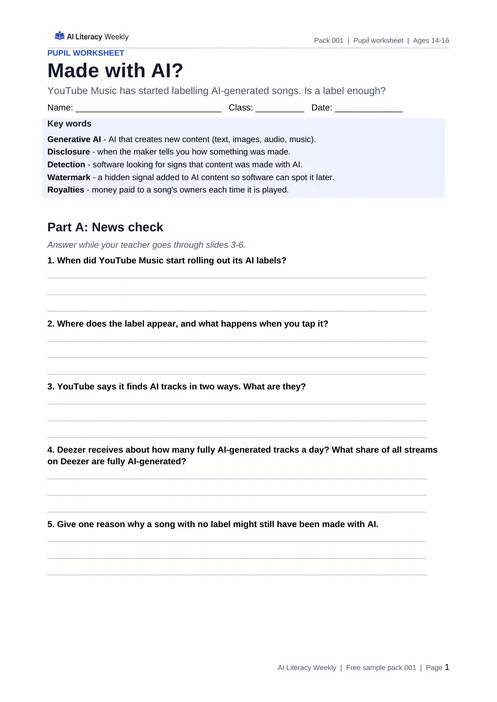
- Pupil worksheet: news check, card sort, platform comparison, debate and exit ticket
- Teacher guide with background, a fact check, answers and safeguarding notes
Curriculum links (England)
| Area | How this lesson covers it |
|---|---|
| Computing KS4 | How new technology such as AI music and voice copying affects safety and identity online, and how platforms respond; how detection, watermarks and metadata work at a simple level. |
| Computing KS3 | Trustworthiness of digital content, and designing a better label (11-14 version). |
| RSHE: online safety and awareness | Spotting and questioning AI-made content, the limits of labels, deepfakes and voice copying of real people, and thinking critically about new technology. |
| PSHE: living in the wider world | Media literacy and digital resilience: evaluating content and sources, and how platforms shape what we see and hear. |
| Citizenship | Should companies set their own rules, or should the law decide? A structured debate using evidence (KS4); comparing platforms' rules and who they are fair to (KS3). |
| Tutor time | Current affairs and digital citizenship, using the 20-minute version. |
Safeguarding
One card links to deepfakes and voice copying, so the teacher guide suggests keeping examples to famous or made-up people. No pupil needs an AI account or a device.